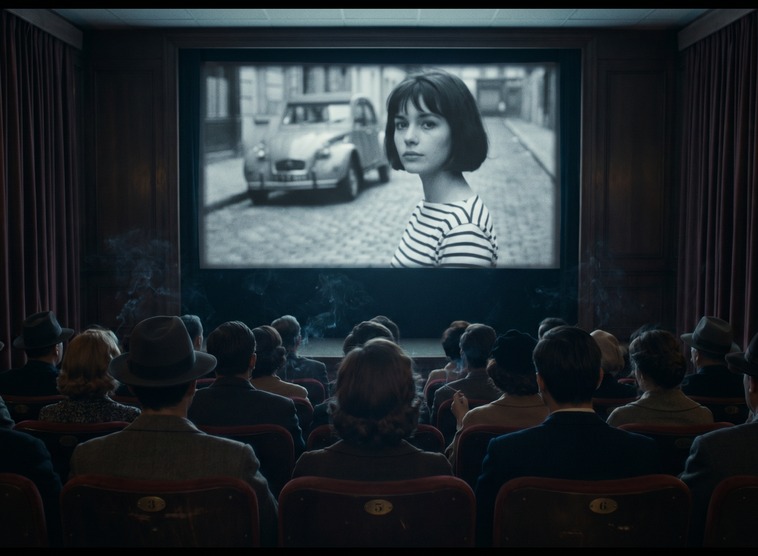
Somewhere in the middle of Jean-Luc Godard's À bout de souffle, Jean-Paul Belmondo's Michel Poiccard turns to Jean Seberg's Patricia and asks her what she thinks about between saying what she wants to say and actually saying it. It is a question that has no clean answer, and Godard knows it. The camera watches Patricia's face as she considers. In the silence, you understand something about the French language that no grammar book has ever managed to explain: that the pauses are as important as the words, and that what is left unsaid is often the point.
Cinema as Classroom
French cinema has always been more than entertainment. It has been a space for the language to perform itself — to show what it sounds like in anger, in seduction, in argument, in exhaustion. To watch a Jacques Audiard film — A Prophet, Rust and Bone, Dheepan — is to hear French spoken in registers that no classroom fully prepares you for: the French of the banlieue, of the prison yard, of the immigrant community navigating a language that is both theirs and not theirs. It is the French of social complexity, and it is intensely alive.
For language learners, film offers what the textbook cannot: the full bandwidth of human communication. The way a character pauses before a difficult sentence, the way a word is softened or sharpened by context, the way a seemingly simple phrase — ça va — carries entirely different weight depending on who says it and when. These are things that only exposure to authentic language, in its natural habitat, can teach. Film is one of the richest forms of that exposure available.
A Brief Film Syllabus
The canon of French cinema is large and argumentative and alive — and every decade adds to it. La Règle du jeu (Renoir, 1939) is the one that critics usually put first: a country house weekend in which the French class system reveals itself through comedy and then catastrophe, in language that is precise, ironic, and utterly of its moment. Les Quatre cents coups (Truffaut, 1959) offers the French of childhood and adolescence — direct, unguarded, sometimes brutal — in the voice of a thirteen-year-old who has decided that the adult world is not to be trusted. Amélie (Jeunet, 2001) is the film that has probably introduced more non-French speakers to the language than any other: its Paris is heightened and whimsical, but the French is real, and Audrey Tautou's voice is a pleasure to follow.
More recently, Les Misérables (Ly, 2019) — not the musical, but Ladj Ly's devastating portrait of the Paris suburbs — offers French at its most contemporary and its most urgent. Portrait of a Lady on Fire (Sciamma, 2019) gives you the French of the eighteenth century, carefully researched and beautifully spoken, and the silence between two women who are falling in love and trying not to. Each of these films is a language lesson disguised as art — which is, of course, the best kind.
How to Watch for Language
There is a way of watching French films that accelerates language acquisition, and it is not simply watching with subtitles. The most useful practice is to watch a scene first with French subtitles, noting not just the words but the rhythm and music of the speech; then to watch it again without subtitles, relying on what you have retained; then to watch a third time and pay attention to what you still cannot catch. The third viewing reveals your frontier — the place where your comprehension runs out and the authentic language begins. That frontier is where the learning happens.
At The French Atelier, teachers like Charline from Paris and Shanice from Montpellier draw on film regularly — not as entertainment breaks between grammar drills, but as primary texts, as examples of French as it is really spoken in the world. A line from a Godard film, a speech from a Truffaut protagonist, a piece of dialogue from Audiard: these are the real curriculum, taught by people who have grown up with this language and this cinema, and who know what the words feel like from the inside.
The Cinema as Cultural Archive
French cinema is also, and perhaps above all, a way of understanding France. The films of the 1950s and 60s are full of the postwar mood — the ambivalence, the reconstruction, the particular joy of a country finding pleasure again after years of deprivation and shame. The films of the 80s and 90s document the changes brought by immigration, by suburban growth, by the slow transformation of a largely homogeneous nation into a more complicated one. Contemporary French cinema — which is some of the most interesting cinema being made anywhere — is grappling with inequality, with identity, with what France means in the twenty-first century.
To watch French films is to watch France thinking. And to watch France thinking, in French, with the language becoming clearer with each film, is one of the most pleasurable educations available to anyone who has decided that French is worth the effort. It is. It is absolutely worth the effort. And the effort is the cinema.