A Culinary Journey Through France

Gastronomy & Travel

A Culinary Journey
Through France

From the boulangeries of Lyon to the oyster beds of Brittany — how the French table is not merely a meal, but a language unto itself, spoken region by region.

There is a phrase the French use when a meal has gone particularly well: on s'est régalés — we treated ourselves royally, we feasted. The verb se régaler carries within it an entire philosophy: that eating is not fuel, but ceremony; not maintenance, but memory. To travel through France with an appetite — for food, for language, for the culture that binds the two together — is to discover a country that has elevated the act of sitting at a table into one of its highest art forms.

The Market as Morning Ritual

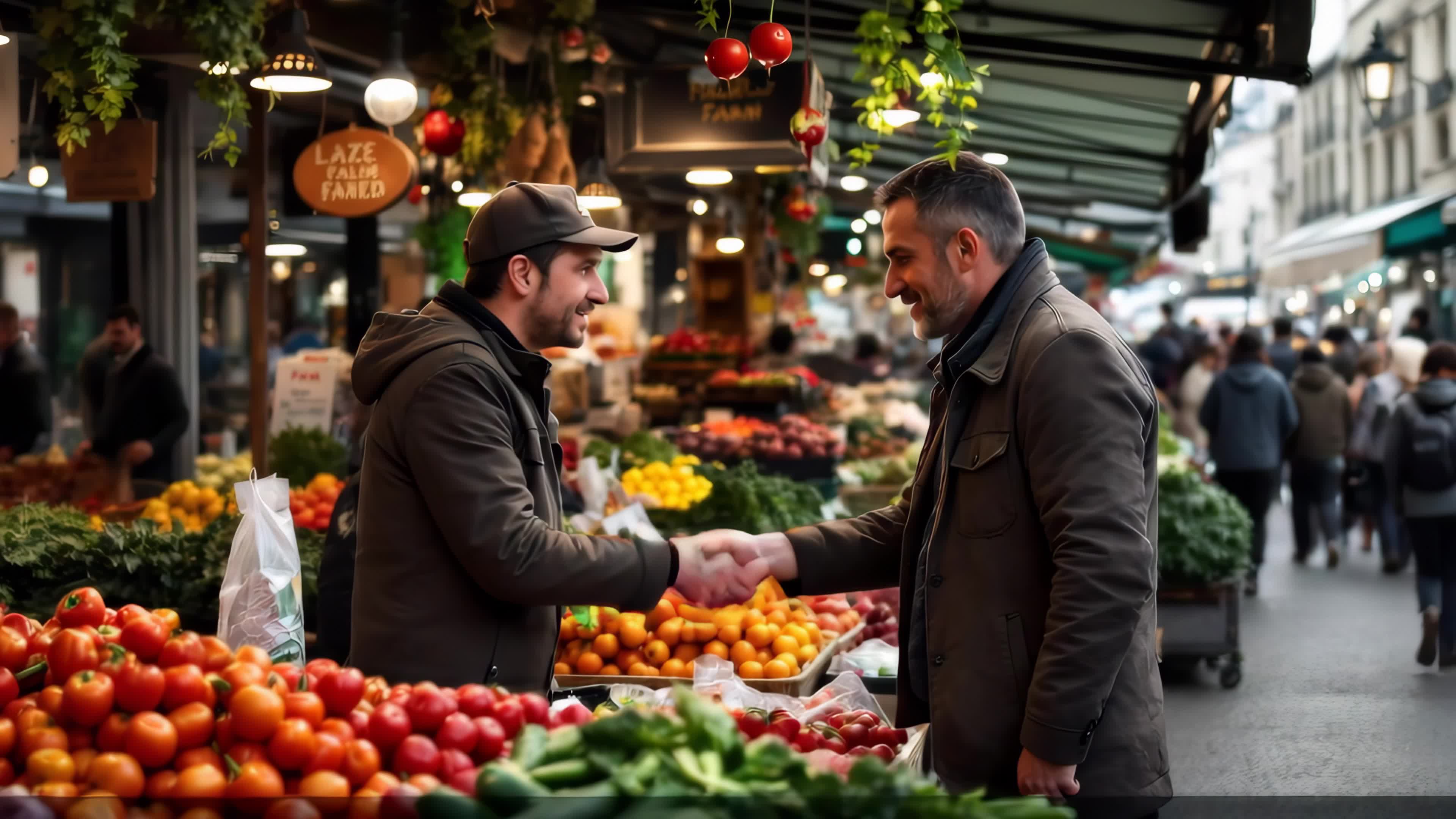
Begin anywhere in France on a market morning and you will understand immediately why the French speak of their food the way others speak of music or painting. In Lyon, the marché at Quai Saint-Antoine stretches along the Saône with a discipline that is almost theatrical: fromagers arranged in ascending intensity of aroma, charcutiers who have been in the same spot for three generations, fishmongers whose ice is changed before dawn. To shop here is to be drawn into a ritual that predates the supermarket by several centuries.

What strikes the visitor who speaks even a little French is how much the language opens these transactions. The fishmonger who might offer you a stiff bonjour with a pointed finger becomes, when you ask in French which of the sea bass were caught last night and which the day before, a professor with an opinion. The French have a word for this quality: convivialité — and it is impossible to manufacture without the language.

Region by Region: A Grammar of Flavours

To understand French cuisine is to understand that there is, in truth, no single French cuisine — only an accumulation of regional dialects, each as distinct as the accent of its people. Brittany is butter and seafood: flat oysters from Cancale, buckwheat galettes with salted butter that is almost aggressively good, cider that pours amber and stings pleasantly at the back of the throat. Provence is olive oil, tomatoes cooked slow, lavender honey, and the distant note of the sea even when you are deep in the Luberon hills. Alsace belongs to another world entirely — choucroute and Riesling, half-timbered inns, a cuisine that acknowledges its German neighbour without losing its French soul.

The Loire Valley, home to one of the French Atelier's foundational course modules, offers a gentler vocabulary: white wines of breathtaking minerality, freshwater fish from the river, rillettes spread thick on sourdough, goat's cheeses — Valençay, Selles-sur-Cher — that taste of the chalk beneath the vine. These are not merely foods; they are texts, and the language in which they are written is French.
"To eat in France is to read its history — every dish a chapter, every table a conversation, every meal a reason to stay a little longer."

Gastronomy & Wine — the vineyard as classroom
The pâtisserie window: where French precision meets pleasure
Wine tasting in France — the language of the cellar, taught in context

The Language of the Table

French food vocabulary is extraordinarily precise because the culture that produced it demands precision. The difference between a braisé and a poêlé, between a brunoise and a julienne, between a wine described as charnu (fleshy) and one described as élancé (slender) — these distinctions are not pedantry. They are the lexicon of a civilisation that takes pleasure seriously. When you learn French, you inherit this vocabulary. You gain, without effort, a more precise language for pleasure itself.

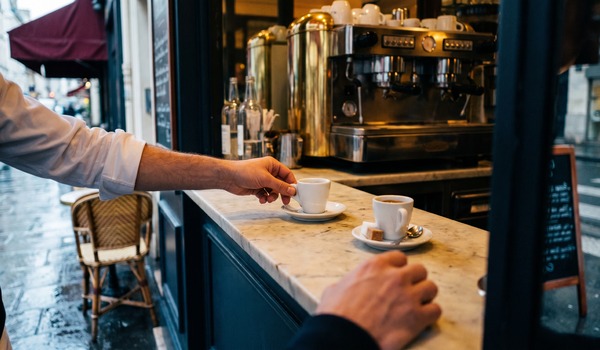
At The French Atelier, our teachers — each based in a different French region — bring the table into the classroom. A lesson set in the market of Pau with Corentin is also a lesson in the Gascon vocabulary of duck and foie gras. A class from Carmèle in Paris explores the bistro as a social institution, not merely a restaurant. You learn to order, to compliment, to decline politely, to ask what is in season — and in doing so, you acquire something no phrasebook can give you: ease.

The Meal as Duration

Perhaps the most radical thing about French food culture, for those coming from places where lunch is a sandwich eaten at a desk, is the idea that a meal has a proper length. Sunday lunch in France is not a meal — it is a commitment. It begins at noon and ends when the cheese board has been returned to the fridge and the last of the wine has been poured. Conversation is the primary activity; eating is what sustains it. The two are not separable.

This is why learning French is, in some sense, learning to eat — or rather, learning to be present at a table in the way the French understand it. The language gives you the tools: the subjunctive to express doubt about whether the soufflé will rise, the conditional to wonder what might pair better, the imperfect to recall last summer's holiday and the lamb at the auberge in the Aveyron that you have not stopped thinking about since.

A Final Table

If there is a single dish that encapsulates the French relationship between food, language, and culture, it may be the pot-au-feu — that long-simmered broth of beef and root vegetables that has been on French tables since the Middle Ages. It is honest, it is slow, and it requires someone at the stove who cares. When you sit down to it, in a farmhouse in Burgundy or a 6th-arrondissement apartment, you are eating something that belongs to a very long conversation. Learning French is how you earn your seat at that table.

Continue the Journey

Learn the language of the French table

Our live courses — broadcast from France's most beautiful regions — teach you French the way it is spoken at the market, the café, and the dinner table.

Continue Reading