The 14th of July is not, strictly speaking, the anniversary of the storming of the Bastille — though that is what most people outside France believe. It is the anniversary of the Fête de la Fédération of 1790, a celebration held one year after the storming, when representatives from all the departments of France gathered on the Champ de Mars to swear loyalty to the new constitutional order. The distinction matters, because France's national day is not a celebration of destruction but of unity — of the idea, radical and fragile and never fully completed, that a nation can be a contract between equal citizens rather than a birthright of the powerful.
The Morning: The Parade
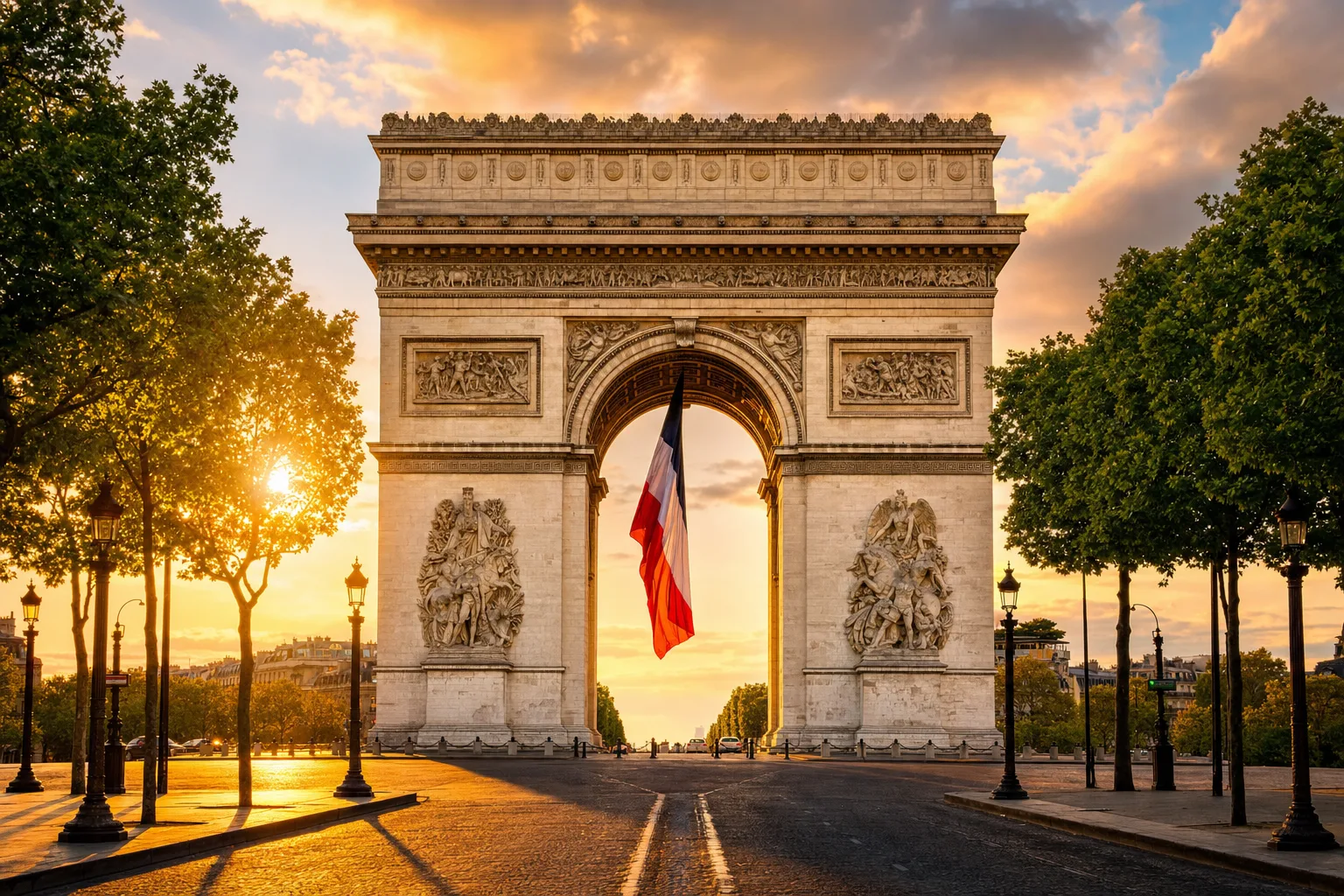
The day begins early on the Champs-Élysées. By eight in the morning, the crowds have claimed their spots along the pavement, many having arrived at dawn with folding chairs and paper bags of croissants. The military parade — the oldest and most elaborate of its kind in Europe — moves down the avenue from the Arc de Triomphe toward the Place de la Concorde, where the President and assembled dignitaries watch from a reviewing stand. There are cavalry, drums, the clatter of horses on cobblestones, ranks of soldiers from France's military academies, and, overhead, the thunderous display of the Patrouille de France drawing blue, white, and red across the Parisian sky.
The parade is magnificent and slightly anachronistic and entirely French — which is to say that it is performed with a seriousness of purpose that is impossible to separate from its ceremonial grandeur. The French do not find the military parade pompous. They find it moving, in the way that a very old ritual is moving: because it has been performed before, by people who are now gone, for reasons that have not entirely disappeared.
The Afternoon: The City at Leisure
After the parade, Paris disperses. Some go to the municipal balls — the bals des pompiers, the Firemen's Balls, held at fire stations across the city on the night of the 13th and continuing into the 14th — where the dancing is earnest and the wine is cold and the queue to get in stretches around the block. Others take to the parks: the Trocadéro garden, the Bois de Boulogne, the Buttes-Chaumont in the 19th, where families set out tablecloths on the grass and eat the kinds of picnics that the French produce without apparent effort. Cold chicken, tapenade, baguette, a wedge of Comté, cherries, a bottle of rosé. The art of the French picnic is the art of the French meal in miniature: generous, unhurried, and slightly better than strictly necessary.
The 14th of July is, among other things, a reminder that France's greatest cultural achievement is not the architecture or the painting or even the cuisine, but the quality of its public life — the vie en commun, the life in common, that happens on the streets and in the parks and at the shared tables where strangers become, for an afternoon, compatriots.
The Evening: Fireworks over the Trocadéro
At eleven o'clock, when the summer dark has finally settled over the city, the fireworks begin. The best vantage point is the Trocadéro, where the Eiffel Tower is lit and the crowd has been waiting, patiently or not, for hours. The display lasts roughly thirty minutes and is choreographed to music — classical pieces, film scores, French chansons — so that the crowd experiences it not merely as spectacle but as a kind of outdoor concert, the sky above the Seine serving as the stage.
There is a moment, every year, when the fireworks reach their climax and the Eiffel Tower erupts in its golden sparkling display, and the crowd — which has been murmuring and exclaiming for half an hour — goes momentarily silent. It is the silence of collective awe, which is different from any other silence. In it, for a few seconds, Paris belongs to everyone equally, and the revolutionary promise of July 1789 — the one that was never quite kept and was never quite abandoned — seems almost, almost possible.
What It Means to Celebrate in French
To experience Bastille Day as a French speaker — even an imperfect one — is to gain access to the commentary that runs alongside the spectacle. The conversation in the crowd about the choice of music, the remarks about which regiment marched best, the explanation offered by a stranger to a child about why the soldiers are carrying those particular flags — these are the texture of the event, and they are conducted in French. The language of celebration, like the language of grief or of love, is its own register, with its own idioms and its own rhythms. To be part of it, rather than a spectator of it, is the difference between attending a ceremony and understanding what the ceremony is for.